

Why Your AI Research Agent Isn't Delivering (And How to Fix It)
88% of enterprises are increasing AI budgets, yet only 21% have deployed agents. Here's why research agents stall—and how to actually get value from them.
The promise of AI research agents is intoxicating: autonomous systems that comb through data, synthesize insights, and deliver answers while you focus on higher-value work. Vendors at GTC 2026 are demoing multi-agent orchestration. NVIDIA is showcasing "build-a-claw" stations where attendees deploy agents in minutes. McKinsey reports that 88% of enterprises plan to increase AI budgets specifically for agentic AI.
So why are only 21% of senior managers actually implementing them?
This isn't a technology problem. It's an execution gap—and it's costing organizations millions in productivity losses while their competitors figure it out.
The market has budget and pilots. The gap is production implementation.

The Harsh Reality: Adoption Is Broad but Shallow
The numbers paint a sobering picture. While nearly every Fortune 500 company is experimenting with AI agents, research from PwC, Deloitte, and industry analysts reveals that enterprise adoption remains frustratingly shallow:
- 88% plan budget increases for agentic AI (McKinsey)
- 79% say AI agents are being adopted in their companies (PwC)
- Only 21% of senior managers have started implementation (TST Technology)
- 90% of companies are stuck in early pilot stages (industry estimates)
- 42% require access to eight or more data sources just to deploy agents successfully
- 86% need significant upgrades to existing tech stacks
Even among "adopters," the reality is often underwhelming. Most employees are using basic agentic features built into enterprise apps—surfacing insights, updating records, answering questions. Useful, yes. Transformative? Not even close.
As one Deloitte analyst noted: "Reports of full adoption often reflect excitement about what agentic capabilities could enable—not evidence of widespread transformation."
Why Research Agents Stall: The Six Failure Modes
After analyzing deployment failures across dozens of enterprises, six consistent failure patterns emerge. If your research agent isn't delivering, it's likely hitting one (or more) of these walls.
1. The Data Fragmentation Trap
The problem: 42% of enterprises need access to eight or more data sources to deploy AI agents successfully. But most organizations suffer from fragmented systems and weak integration, preventing agents from synthesizing insights across data streams.
What it looks like: Your agent can search your document store but can't access your CRM. It can query your knowledge base but misses context from recent Slack discussions. It produces answers that are technically correct but operationally incomplete.
The fix: Map your data ecosystem before deploying. Prioritize agents that can federate across sources—or accept that limited data access means limited value. The research agents that deliver are the ones connected to all relevant context, not just the convenient repositories.
2. Security and Governance Paralysis
The problem: Security concerns rank as the top challenge for both leadership (53%) and practitioners (62%). In PwC's survey, 28% of firms placed trust and safety among their top three concerns—particularly regarding financial and autonomous decision-making processes.
What it looks like: Months spent on security reviews. Legal teams blocking deployment over data handling questions. IT architects designing elaborate sandbox environments that neuter agent capabilities. By the time governance is "solved," the business problem has evolved.
The fix: Start with low-risk use cases where agent outputs are recommendations, not actions. Build audit trails from day one. The organizations that scale fastest adopted a "trust but verify" model—human-in-the-loop validation for high-stakes decisions, autonomous execution for low-risk tasks.
3. The Integration Complexity Wall
The problem: While 90% of enterprises view integration with organizational systems as "essential," nearly half report their existing integration platforms are only "somewhat ready" for AI's data demands. Most agent frameworks integrate with fewer than 20 applications out-of-the-box—yet enterprises run hundreds.
What it looks like: Agents that work beautifully in demos but require extensive engineering to connect to your actual CRM, ERP, and custom APIs. Integration projects that balloon from weeks to quarters. Promised "out-of-the-box" connectors that need heavy customization.

The fix: Be ruthless about use case selection. The fastest wins come from agents operating in environments with clean APIs and structured data—think well-documented SaaS platforms, not legacy on-premise systems with custom schemas. Integration complexity is often a bigger blocker than AI capability.
4. Skills and Operational Gaps
The problem: Insufficient worker skills rank as the biggest barrier to integrating AI into workflows (Deloitte). The absence of mature AI governance and orchestration professionals means scaling pilots to production is painfully slow.
What it looks like: Data scientists who can build models but can't operationalize them. IT teams who understand infrastructure but not AI workflows. Business units excited about possibilities but unclear on implementation. Everyone waiting for "someone else" to figure it out.
The fix: Cross-functional teams from day one. The most successful deployments paired data engineers with domain experts, security leads with product managers. AI agent deployment isn't a technical problem solved by technical teams—it's an organizational capability gap that requires hybrid expertise.
5. The Pilot-to-Production Chasm
The problem: Most organizations run isolated pilot agents that never integrate with production systems. Gartner predicts that over 40% of agentic-AI projects will be canceled by 2027 due to unclear value, integration difficulty, or governance issues.
What it looks like: Impressive POC results that never ship. Agents that answer questions brilliantly but can't trigger workflows. Successful pilots that die in "production readiness" reviews. Months of work producing demos, not deployed capabilities.
The fix: Design for production from the first sprint. If your pilot architecture can't scale—governance, logging, error handling, rollback capabilities—you're not building a pilot. You're building technical debt. The organizations that scaled fastest treated their pilots as production prototypes, not throwaway experiments.
6. Unrealistic Expectations About Autonomy
The problem: Current "Agent 1.0" systems—powered by large language models—can retrieve information and use tools but fall short in enterprise context decision-making. Yet vendors sell them as autonomous decision-makers.
What it looks like: Disappointment when agents make obvious errors in domain-specific contexts. Frustration when agents can't handle edge cases that humans navigate intuitively. Abandoned projects because "the AI isn't smart enough."
The fix: Match autonomy to capability. Today's agents excel at research, summarization, and structured task execution. They struggle with nuanced judgment, cross-domain reasoning, and high-stakes decisions. Design workflows where agents handle the 80% of repetitive research tasks, leaving the 20% of complex analysis to humans.
What the Winners Are Doing Differently
For all the deployment failures, some organizations are getting value from research agents. The patterns are consistent—and replicable.
They Started with IT Service Desk Automation
IT service desk automation ranks as the top business use case (61% of enterprises). Why? Structured data, clear decision rules, low stakes, and immediate productivity impact. The organizations that scaled started here, proved value, then expanded.
They Built Auditability From Day One
CIOs consistently cite traceability, audit logs, and human-in-the-loop fail-safes as prerequisites for trust. The fastest-scaling organizations didn't treat these as afterthoughts—they were requirements in the first sprint.
They Rethought Workflows, Not Just Optimized Them
Only 34% of organizations are truly reimagining their businesses rather than optimizing what exists. But that 34% is capturing disproportionate value. They didn't ask "How do we add AI to our research process?" They asked "If we had infinite research capacity, what would we do differently?"
They Invested in Integration Infrastructure
The 42% of enterprises planning to build over 100 agent prototypes—and the 68% budgeting $500,000+ annually on AI agent initiatives—are learning a hard truth: integration complexity scales with deployment scope. Winners invested in unified integration platforms early, avoiding the "patchwork approach" that creates tomorrow's technical debt.
A Practical Roadmap: From Pilot to Production
If you're stuck in the adoption gap, here's a battle-tested sequence:
Phase 1: Foundation (Weeks 1-4)
- Map your data sources and integration requirements
- Identify 2-3 low-risk use cases with structured data
- Establish governance framework and audit requirements
- Assemble cross-functional team (data, security, domain, IT)
Phase 2: Pilot (Weeks 5-12)
- Deploy agents in limited scope with human-in-the-loop
- Measure baseline metrics: time-to-answer, coverage, accuracy
- Build logging, monitoring, and rollback capabilities
- Document failure modes and edge cases
Phase 3: Integration (Weeks 13-20)
- Connect to production systems (CRM, document stores, communication tools)
- Implement automated quality checks
- Train end users on effective collaboration patterns
- Establish feedback loops for continuous improvement
Phase 4: Scale (Weeks 21+)
- Expand to adjacent use cases
- Reduce human-in-the-loop frequency for proven workflows
- Develop multi-agent orchestration for complex tasks
- Measure business impact: cost reduction, time savings, decision quality
The Bottom Line
The AI research agent market is experiencing classic hype cycle dynamics: massive interest, inflated expectations, and inevitable disappointment when reality doesn't match demos. But underneath the noise, real value is being created—just by organizations willing to do the hard work of integration, governance, and workflow redesign.
The 88% of enterprises increasing AI budgets aren't wrong about the opportunity. They're just underestimating the execution complexity. The winners won't be the ones with the most advanced models or the biggest budgets. They'll be the ones who treated agent deployment as an organizational transformation, not a technology purchase.

Your research agent isn't failing because AI isn't ready. It's failing because deployment is hard—and most organizations are still learning how to do it well.
Rabbit Hole is an AI research agent that actually delivers. It connects to your documents, web sources, and internal systems to provide cited, verifiable research—not hallucinated summaries. Deploy it in minutes, scale it as you learn.
Related Articles

The 2026 Buyer's Guide to AI-Powered Research Assistants
The best ai-powered research assistant in 2026 depends on whether you need a fast answer, a literature workflow, or a report you can actually defend after the meeting.

ChatGPT Deep Research vs Perplexity vs Rabbit Hole: Which One Cites Sources That Actually Exist?
If a deep research tool gives you a polished paragraph with one dead link or one unsupported claim, the report is already compromised. Here is the citation test that matters.
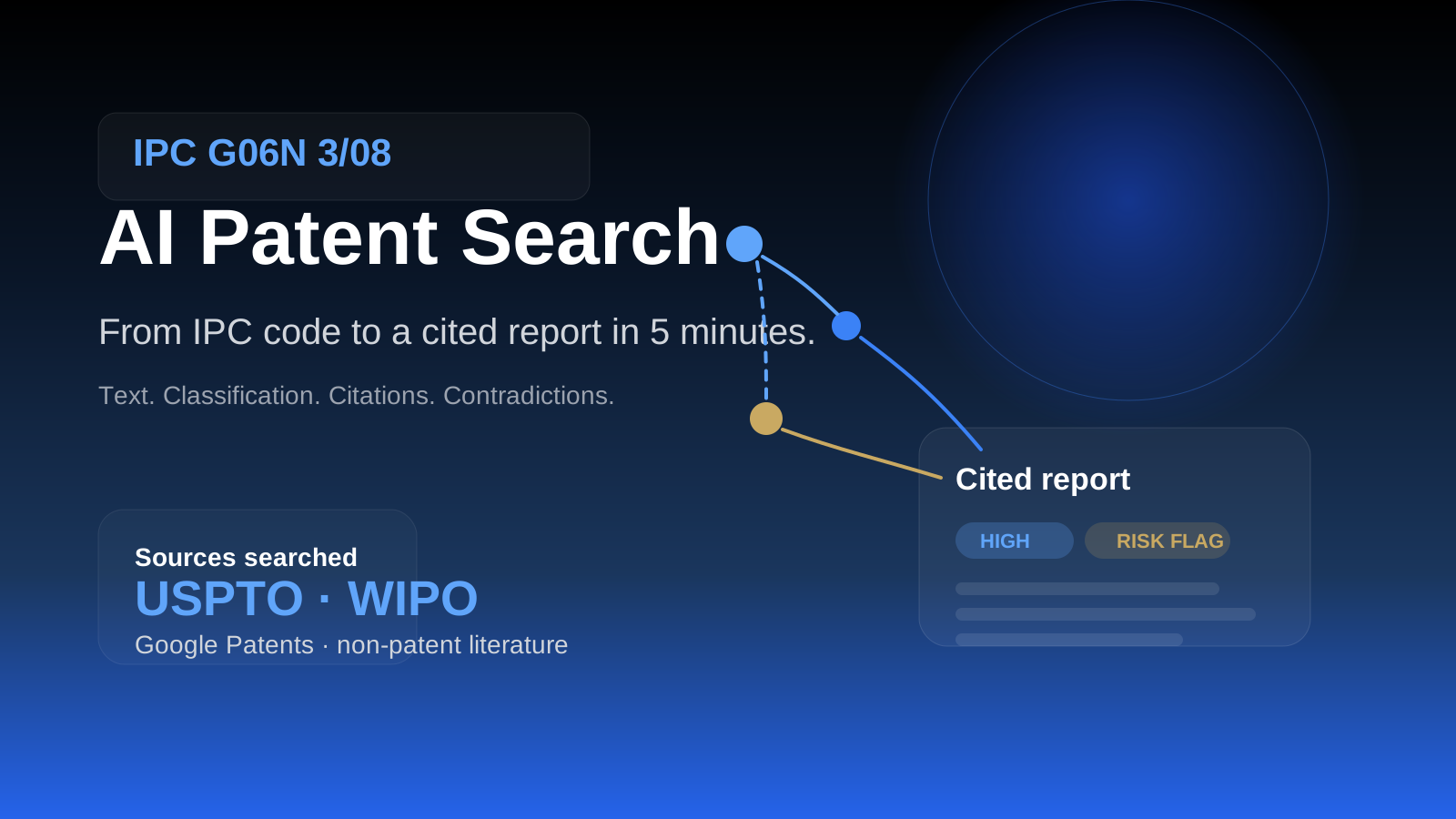
AI Patent Search: From IPC Code to Cited Report in 5 Minutes
Patent search is not one query. It is text, classification, citations, and non-patent literature across multiple databases. Here is the workflow that gets you from an IPC code to a cited report faster without pretending verification is optional.
Ready to try honest research?
Rabbit Hole shows you different perspectives, not false synthesis. See confidence ratings for every finding.
 Try free