

How to Research Breaking Tech News Without Drowning in It
A practical framework for staying informed during live tech events without the information overload and FOMO that tanks productivity.
GTC is next week. Apple's WWDC is around the corner. Every Tuesday some AI lab drops a new model with a 47-page technical report. If you're a knowledge worker, investor, founder, or analyst, staying current isn't optional—it's your job. But there's a cost.
A 2024 study from the University of Nottingham found that 76% of global workers say information overload contributes to their daily stress. Not just stress, but something more specific: "informational Fear of Missing Out" (IFoMO). The anxiety that while you're focusing on one thing, something critical is happening somewhere else. The researchers linked IFoMO directly to exhaustion and poorer mental health outcomes.
This isn't abstract. During live tech events—GTC, Google I/O, OpenAI's surprise drops—your Slack lights up, Twitter becomes unreadable, and every publication is live-blogging the same keynote. The fear of missing the one detail that matters drives you into a spiral of tab-hoarding, half-read threads, and scattered notes you'll never revisit.
There's a better way. Not to opt out—to opt in intelligently. This is a framework for researching breaking tech news in real-time without letting it break you.
The Problem: Speed vs. Accuracy vs. Sanity
Breaking tech news presents a trilemma. You can have speed, accuracy, or your sanity. Pick two.
Speed + Accuracy = No Sleep. You could manually verify every claim by checking primary sources, reading technical papers, and cross-referencing across outlets. This produces reliable knowledge. It also produces burnout. During a major announcement, you'll be 47 tabs deep while the conversation has already moved on.
Speed + Sanity = Misinformation. You skim headlines, trust viral threads, and form opinions based on the loudest voices. You stay current. You also stay wrong. A 2026 analysis found that 60% of viral breaking news contains inaccuracies initially. Tech Twitter amplifies speculation at the same velocity as verified facts.
Accuracy + Sanity = Irrelevance. You wait for the dust to settle, read the recaps, and form considered opinions. You're well-rested and correct. You're also late. In fast-moving domains—AI, crypto, biotech—being 48 hours behind means missing the window where decisions matter.
"The people who survive information overload aren't those who process faster. They're those who say 'not relevant' faster."
The Research Reality
The post above described impossible trade-offs. Here's what the data says about who's actually winning. This challenge of doing more research with less productive output isn't new—see the decades-long decline in research productivity and why R&D budgets keep growing just to maintain the same output.
The framework below is designed to thread this needle. It prioritizes triage over comprehensiveness, primary sources over commentary, and structured capture over frantic consumption.
Phase 1: Pre-Event Setup (Do This Before the Keynote)
Most information overload during live events is self-inflicted. You haven't decided what you're looking for, so you consume everything. The antidote is constraint. (If tab overload is your bigger problem, see how tab hoarding kills productivity.)
Define Your Informational Edge
Before any major event, answer one question: What would I need to learn to make a decision I can't currently make?
- Investors: What capability would change your thesis on a company or sector?
- Founders: What technical breakthrough would invalidate or accelerate your roadmap?
- Operators: What tooling change would require immediate procurement decisions?
- Researchers: What methodological advance would you need to replicate?
Write this down. One sentence. This is your filter. During the event, 90% of announcements won't touch this question. You can ignore them without FOMO.
Curate Your Primary Sources
Most people consume breaking news through aggregators—Techmeme, Twitter, newsletter roundups. This is backwards. Aggregators are useful for discovery, but they're terrible for verification. By the time a claim reaches Techmeme, it's already been filtered through multiple intermediaries.
Before the event, identify your primary sources:
For product announcements: The company's official accounts, press release RSS feeds, and technical blogs For academic breakthroughs: ArXiv, the authors' Twitter accounts, and the paper's GitHub repo For market moves: SEC filings, official partnership announcements, and earnings calls For technical specs: Documentation sites, API changelogs, and developer forums
Set up dedicated lists or feeds for these sources. During the event, check these first. If the primary source hasn't confirmed it, treat it as speculation regardless of how many outlets are repeating it.
Prepare Your Capture System
Information overload happens when consumption outpaces processing. You read faster than you can organize, so you open tabs as a form of deferred processing. Those tabs become anxiety artifacts—visual reminders of things you haven't dealt with.
The fix is a two-tier capture system:
Tier 1: Real-time notes. A single document for raw observations during the event. No organization, no formatting, just timestamps and claims. "14:32 - Jensen mentions 100x inference speedup on H100. Check: is this vs A100 or vs last gen?"
Tier 2: Verification queue. A separate list for claims that need follow-up. "Find: actual TFLOPS numbers from today's keynote. Source: NVIDIA blog post or technical brief, not TechCrunch summary."
The rule: Tier 1 gets filled during the event. Tier 2 gets cleared after. Never try to verify in real-time. The goal during the event is documentation, not understanding.
Phase 2: Live Event Protocol (During the Announcement)
When the keynote starts, your job changes. You're no longer researching. You're collecting raw material for later research.
The 5-Minute Rule
For any breaking claim, wait five minutes before acting on it. This is your speed bump against reactive sharing. In the first five minutes after an announcement:
- Journalists are filing initial takes based on liveblogs
- Threadbois are drafting viral summaries
- Analysts are checking if the stock is moving
Nobody has depth yet. The value of being first to react is an illusion. The first accurate analysis always beats the first analysis.
Use those five minutes to capture the claim in your Tier 1 notes with proper attribution. "Claim: New model achieves SOTA on MMLU. Source: CEO live keynote, 23:15 mark. Unverified."
Lateral Reading, Not Deep Diving
When you encounter a surprising claim, the instinct is to dive deep—open the paper, read the methodology, understand the caveats. This is a trap during live events. You'll spend 30 minutes on one claim and miss ten others.
Instead, practice lateral reading: spend 30 seconds checking if other credible sources are confirming the same thing. Don't read the full articles. Check headlines, skim ledes, look for consensus or contradiction. Then capture the claim and move on.
The goal isn't to understand the claim in real-time. It's to know whether the claim is solid enough to investigate later.
Quantify, Don't Qualify
Breaking news coverage is heavy on adjectives and light on numbers. "Revolutionary breakthrough" tells you nothing. "32% efficiency improvement on ResNet-50" tells you something.
When capturing claims, convert qualitative language to quantitative where possible:
- "Much faster" → "__x faster (baseline unclear)"
- "State of the art" → "SOTA on __ benchmark (previous SOTA: __)"
- "Industry leading" → "__ metric vs competitor __"
The blanks are your verification targets. You can't evaluate a claim without knowing what it's being compared to.
Manage the Firehose
During major events, information arrives faster than you can process it. This is where your pre-defined edge matters. For every piece of information, ask: Does this change anything I'll do today?
If the answer is no, archive it without reading. If the answer is "maybe, but not urgently," add it to your Tier 2 verification queue. If the answer is yes, capture it in Tier 1 and return to it after the event.
The people who survive information overload aren't those who process faster. They're those who say "not relevant" faster.
Phase 3: Post-Event Processing (The Real Work)
The event ends. Your Tier 1 document is a mess of timestamps and half-captured claims. Your Tier 2 list is longer than you'd like. Now the actual research begins.
Triage Your Verification Queue
Not everything in Tier 2 needs immediate attention. Sort by decision urgency:
Today: Claims that affect decisions you need to make before markets close, before a meeting, before a deadline This week: Claims that affect strategy but not immediate tactics This month: Interesting developments that don't require action Never: Claims that felt important in the moment but don't connect to any actual work
Be aggressive about that last category. Most of what feels urgent during live events is just loud. If it doesn't connect to a decision, it's entertainment, not information. There's nothing wrong with entertainment, but don't confuse the two.
Go Upstream to Primary Sources
For anything in your "Today" or "This week" buckets, find the original source. Not the TechCrunch summary. Not the Twitter thread. The actual source.
- Company announcement → Read the press release, then the technical blog post, then the documentation
- Research paper → Read the abstract, then the conclusion, then the methodology if the claims are surprising
- Market move → Read the SEC filing, then the earnings transcript, then the analyst notes
This is slow. That's the point. Speed is for collection, not comprehension.
Cross-Reference Claims
Once you have the primary source, check for disagreement. Look for:
- Technical coverage: Ars Technica, AnandTech, ServeTheHome for hardware; Papers With Code for AI benchmarks
- Skeptical voices: Researchers in the field, competitors, short-sellers (for public companies)
- Historical context: How does this compare to previous claims from the same source? Track records matter
If multiple independent sources confirm a claim, you can provisionally accept it. If there's significant disagreement, you have a research thread, not a conclusion.
Synthesize and Archive
The final step is distilling your research into something you'll actually use. For each verified claim that affects your work, write:
- The claim in your own words (one sentence)
- The source (specific URL, not "some article")
- The confidence level (verified, provisional, disputed, speculative)
- The action it triggers (none, watch, act, decide by date)
Archive this in your knowledge management system. Not scattered across tabs. Not in your head. Somewhere you can find it when you need to make the decision it informs.
The FOMO Antidote: Trust the Recap
The deepest source of information overload is the fear that if you don't watch live, you'll miss something. This is false. Every major tech event generates comprehensive recaps within hours:
- Technical blogs from practitioners who did the deep dive
- Analyst reports with actual numbers
- Podcast discussions with domain experts
- GitHub repos with working code
These recaps are higher quality than your real-time consumption would have been. The people writing them spent all day focused on one thing. You were trying to track twelve.
The optimal strategy for most events isn't live coverage. It's a 48-hour delay. Let the dust settle. Let the smart people do the initial analysis. Then read their synthesis and go upstream for anything that affects your decisions.
When to Break These Rules
There are exceptions:
Trading events: If you're making decisions based on price action, you need real-time information. But you're trading, not researching. Different game, different rules.
Direct competitive threats: If a competitor launches a feature that could kill your business, speed matters. But even here, accurate understanding beats fast misunderstanding.
Your specific edge: If you're one of ten people in the world who can evaluate a technical claim in real-time, use that edge. For everyone else, accept that expertise takes time.
Building the Habit
Researching breaking news efficiently is a skill that compounds. Each event, you learn:
- Which sources are consistently accurate vs. consistently first
- Which claims tend to hold up vs. get walked back
- Which of your "urgent" items were actually irrelevant
Track this. After each major event, spend ten minutes reviewing what you captured vs. what actually mattered. Calibrate your filters. The goal isn't to predict perfectly. It's to miss less badly over time.
The Bottom Line
Information overload isn't a technology problem. It's a prioritization problem. There's always more to know than you can know. The question is whether you're deliberate about what you choose to consume.
During breaking tech news, the crowd optimizes for speed. They want to be first to share, first to comment, first to look informed. You should optimize for accuracy. Be the person who, three days later, actually understands what happened. That's rare. That's valuable. That's survivable.
The framework is simple: Know what you're looking for before the event starts. Capture without judging during the event. Verify without hurrying after it ends. And ruthlessly discard anything that doesn't connect to a decision you need to make.
The news will keep coming faster than you can process it. The only variable is whether you let that fact stress you or guide you.
Rabbit Hole is an AI research assistant that digs deep instead of skimming. Give it a topic, and it searches across sources, checks claims against primary documents, and delivers comprehensive research with citations you can verify.
Related Articles
The 2026 Buyer's Guide to AI-Powered Research Assistants
The best ai-powered research assistant in 2026 depends on whether you need a fast answer, a literature workflow, or a report you can actually defend after the meeting.

ChatGPT Deep Research vs Perplexity vs Rabbit Hole: Which One Cites Sources That Actually Exist?
If a deep research tool gives you a polished paragraph with one dead link or one unsupported claim, the report is already compromised. Here is the citation test that matters.
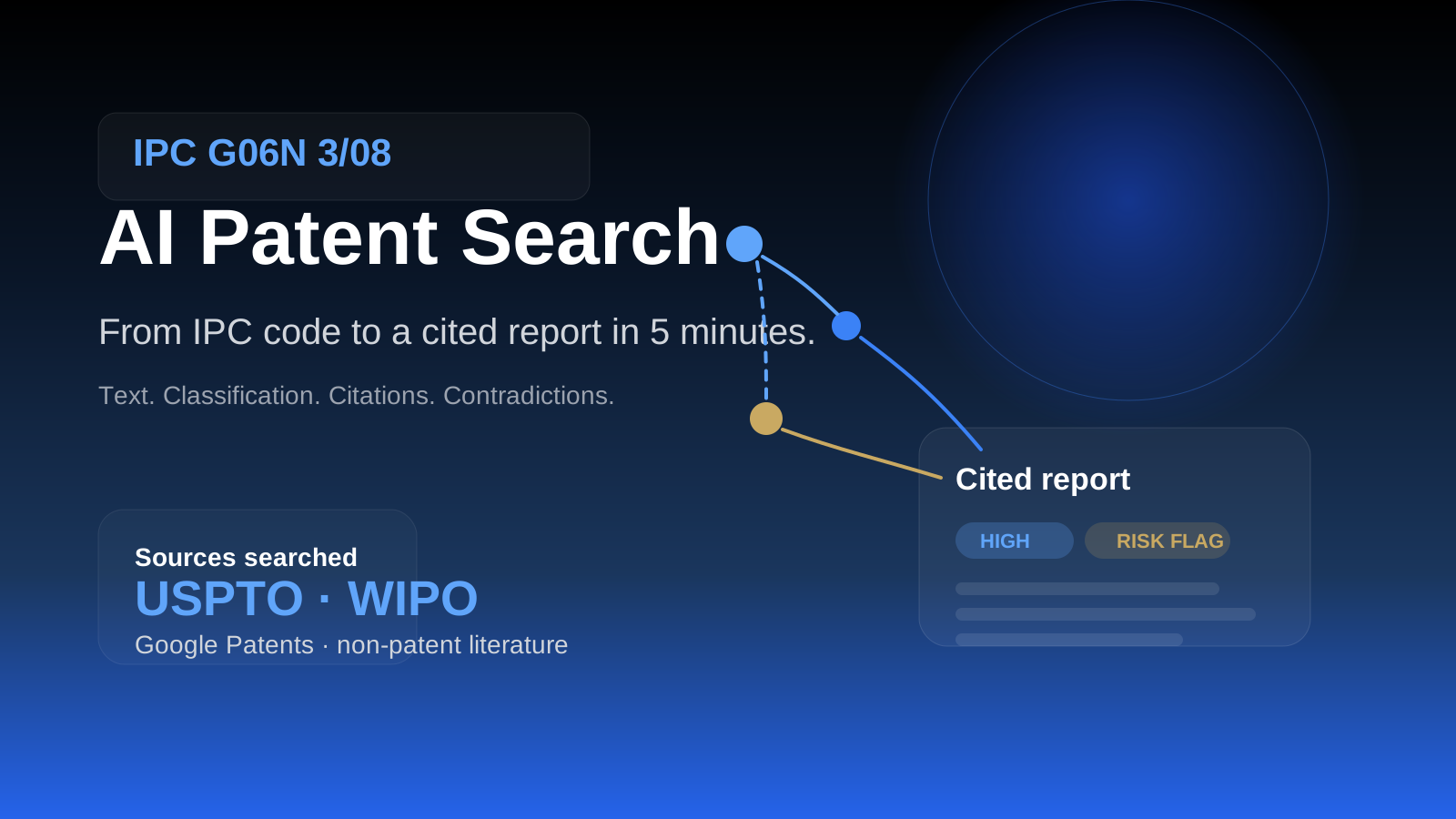
AI Patent Search: From IPC Code to Cited Report in 5 Minutes
Patent search is not one query. It is text, classification, citations, and non-patent literature across multiple databases. Here is the workflow that gets you from an IPC code to a cited report faster without pretending verification is optional.
Ready to try honest research?
Rabbit Hole shows you different perspectives, not false synthesis. See confidence ratings for every finding.
 Try free