

Deep Research Tools Look Credible. That's the Problem.
ChatGPT Deep Research passes the 'looks good to me' test. Studies show 28-55% fabricated citations. Here's why false confidence is worse than no answer at all.
Gary Marcus nailed it: ChatGPT Deep Research outputs "will pass a LGTM test."
LGTM. Looks Good To Me. The report reads professionally. Citations appear at the bottom. The synthesis sounds confident. Ship it.
That's exactly why these tools are dangerous for real work.
The Confidence Calibration Problem
OpenAI's own technical documentation admits their Deep Research feature has "weakness in confidence calibration, often failing to convey uncertainty accurately."
Translation: it sounds confident even when it's wrong.
This isn't a bug they're working on fixing. It's structural. Large language models are trained to produce fluent, coherent text. Hedging language like "I'm not sure" or "evidence is mixed" gets smoothed away because it practices during training. The model learns that confident-sounding responses get higher ratings from human evaluators. Over time, hedging gets eliminated.
The result is what Marcus calls "a dangerous illusion of legitimacy."
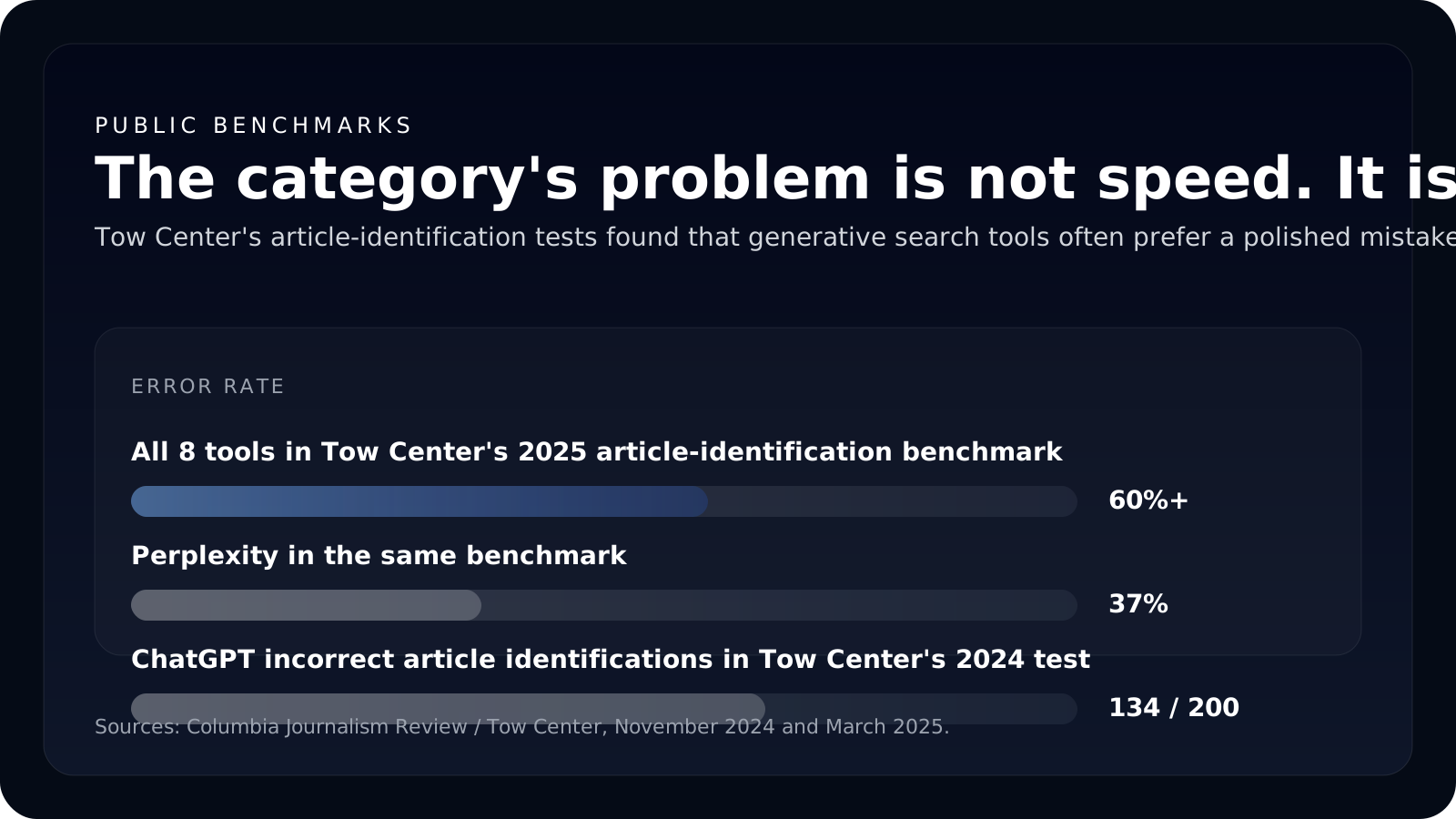
When a tool tells you something confidently and cites sources, you're primed to believe it. When that same tool is wrong 28% of the time on citations—which studies show GPT-4o is for certain medical research topics—you have a serious problem.
But it gets worse. That 28% figure is just for GPT-4o. GPT-3.5, still widely used, hallucinates citations at rates between 39.6% and 55% according to peer-reviewed research published in the Journal of Medical Internet Research. That's not a minor inconvenience. That's a coin flip whether your citation is real.
The danger is not just fake references. Real citations with wrong dates, page numbers, or DOIs still break the evidence trail.
The Citation Fabrication Numbers
Let's talk specifics because vague warnings don't change behavior.
A peer-reviewed study from JMIR examining AI-generated academic references found:
- GPT-3.5: 39.6% hallucination rate
- GPT-4: 28.6% hallucination rate
- Bard/Gemini: 91.4% hallucination rate
That's not a rounding error. When you ask Bard for research citations, you're more likely to get a fabricated reference than a real one.
Another study from Deakin University had GPT-4o write six literature reviews on mental health topics. The results:
- 19.9% of citations were completely fabricated
- 45.4% of real citations contained errors (wrong dates, incorrect page numbers, invalid DOIs)
- Only 43.8% of citations were both real and accurate
The fabrication rate varied dramatically by topic. For major depressive disorder—a well-studied, high-profile condition—only 6% of citations were fake. But for binge eating disorder and body dysmorphic disorder, fabrication rates jumped to 28% and 29% respectively. The AI performs worse on topics with less training data, which unfortunately means it's least reliable exactly when you're researching something specialized.
Here's what makes this insidious: when GPT-4o provided DOIs for fabricated citations, 64% of them linked to real papers on completely unrelated topics. Someone doing a quick spot-check would land on a real article and assume the citation was legitimate. You'd have to actually read the paper to discover it doesn't support the claim at all.
Real-World Consequences: When Fake Citations Meet Reality
Citation hallucinations aren't just an academic problem. They're already causing real damage.
July 2025: A federal judge ordered two attorneys representing MyPillow CEO Mike Lindell to pay $3,000 each after they submitted a court filing filled with AI-generated citations—more than two dozen errors and non-existent case references. This was one of over 206 documented cases where courts have sanctioned attorneys for AI-hallucinated citations.
Medical Research: A paper in the Journal of Medical Internet Research documented how researchers using AI for literature reviews risk building entire research programs on phantom sources. When a cited paper doesn't exist, subsequent researchers waste time trying to locate it. When they can't find it, they may simply cite the same phantom source again, creating a chain of false references that propagates through the literature. If you need the workflow that keeps the speed gains without pretending the citations are trustworthy by default, read our guide to using an AI literature review tool safely.
Investment Decisions: A venture capitalist relying on AI-generated market size data with fabricated citations might make a $10 million investment based on nonexistent research. By the time due diligence catches the error—if it catches it at all—the deal structure and competitive dynamics may have already shifted.
The cost of a single hallucinated citation extends far beyond embarrassment. In academia, it can mean paper rejection, damaged reputation, lost grant funding, and even retractions. In legal practice, it means sanctions and professional discipline. In business, it means bad decisions made with false confidence.
Why We Fall For It: The Psychology of AI Credibility
Understanding why these tools are dangerous requires understanding why we trust them in the first place.
Authority bias: When a system presents information with citations, we treat it like an academic paper. Citations signal expertise. The format triggers our learned response to authoritative sources.
Fluency heuristic: We judge information as more accurate when it's easier to process. AI-generated text is smooth, well-structured, and free of the typos and awkward phrasing that often signal unreliable sources. Our brains interpret this fluency as credibility.
Automation bias: We tend to over-trust automated systems. Studies on airline pilots and medical professionals show that even experienced experts defer to automated recommendations, sometimes against their better judgment. AI research tools trigger the same bias.
Confirmation bias: When AI tells us what we already suspect, we're less likely to verify it. The confident presentation reinforces our existing beliefs, and we skip the critical verification step.
Cognitive offloading: Research is hard. Verification is tedious. When an AI gives us a complete, cited, confidently-stated answer, we're tempted to accept it because the alternative—doing the research ourselves—is cognitively expensive.
These biases aren't character flaws. They're normal human psychology. And AI research tools are specifically designed to exploit them.
Domain-Specific Dangers: Where Hallucinations Hurt Most
Citation accuracy isn't equally important across all fields. Some domains can tolerate higher error rates. Others cannot.
Medical Research: In healthcare, fabricated citations can misdirect treatment protocols, waste research funding on phantom studies, and delay effective interventions. A 2025 study found that nearly 70% of mental health researchers now use ChatGPT for research tasks including literature reviews. If even half of those users don't verify citations rigorously, that's a massive amount of potentially fabricated research entering the academic pipeline.
Legal Practice: Case law builds on precedent. A fabricated case citation doesn't just undermine one brief—it risks contaminating the entire chain of legal reasoning. The 206+ documented sanctions cases represent only the instances that were caught. The true number of undetected AI citations in legal filings is unknown and potentially much higher.
Financial Analysis: Investment theses rely on accurate market data and research. A fabricated citation about competitor performance, market size, or regulatory risk can lead to material investment errors. The confidence of the presentation makes these errors harder to catch—analysts are less likely to question data that arrives looking polished and professional.
Scientific Publishing: The reproducibility crisis in science is well-documented. Adding AI-generated phantom citations makes it worse. When researchers can't locate cited papers, they can't replicate the work. When they build on phantom research, they waste resources chasing effects that may not exist.
The Authorship Question: Who Owns What AI Creates?
The credibility crisis extends beyond citations. On April 28, 2026, a Hacker News discussion titled "Who owns the code Claude Code wrote?" hit the front page with 291 upvotes and 311 comments. The question cut to the heart of the same problem: when AI generates content, who is responsible for it?
The debate revealed deep uncertainty. Is the output copyrighted? Does the user who prompted it own it? Does Anthropic? What happens when AI-generated code contains vulnerabilities—who is liable? These aren't edge cases. They're the fundamental questions that get skipped when we treat AI output as equivalent to human-created content.
The citation problem is part of this same pattern. An AI-generated citation isn't just a formatting error—it's a claim that a human researcher said something they never said. It's putting words in someone's mouth. When that happens in court filings (as it has in 206+ documented cases), it's not a technical glitch. It's a serious ethical breach.
The HN thread surfaced a pattern: developers are increasingly treating AI agents as autonomous collaborators, not tools. "Claude Code wrote this" becomes shorthand for "I didn't write this, but I'm presenting it as my work." This is exactly what happens with citations. "ChatGPT found this research" becomes "I found this research," even when the research doesn't exist.
The solution to both problems is the same: traceability. You need to know what was AI-generated and what wasn't. You need audit trails, not just outputs. You need confidence ratings, not just confident presentations.
When AI authorship is unclear, credibility suffers. The same is true when citation sources are unclear. These aren't separate issues—they're symptoms of the same underlying problem: AI systems that produce finished-looking work without the accountability structures that make finished work trustworthy.
What Honest Research Tools Actually Show
The alternative isn't avoiding AI research assistants entirely. It's demanding honesty about what they found.
An honest AI research tool should:
Show different perspectives, not false synthesis. Academic papers say one thing. Reddit users say another. SEC filings reveal something else. Blending these into a single confident narrative hides important disagreement. Real research shows you the conflict, not a smoothed-over version of it. And when you do publish your findings, they should be laid out in citation-ready structure — direct answers, question-led headings, linked stats, and modular blocks — the same pattern we break down in our guide to AI search optimization for LLM citations.
Provide confidence scores per finding. "3 sources strongly support this claim" is different from "1 blog post mentioned this in passing." You need to see the difference. Confidence should be explicit, not buried in the prose.
Make citation verification trivial. If checking a source requires multiple clicks and context-switching, you won't do it. If it's one click, you might. The easier verification is, the more likely it happens.
Surface uncertainty instead of hiding it. When evidence is thin, say so. When sources contradict each other, show the contradiction. When the AI doesn't know, it should tell you it doesn't know—not make something up that sounds plausible.
Separate search from synthesis. The agent that finds sources shouldn't be the same one that writes the summary. This separation of concerns reduces the incentive to fabricate citations that support a pre-determined narrative.
Practical Verification: How to Check AI Research Output
Until better tools exist, verification is your responsibility. Here's a systematic approach. If you want the full step-by-step version, read How to Verify AI Research Output.
The 5-citation spot check: Pick 5 random citations from any AI-generated research report. Search for each one directly in Google Scholar or PubMed. Don't click the AI-provided link—type the title manually. If more than 1 doesn't exist or doesn't say what the AI claims, the entire output is suspect.
DOI verification: Real academic papers have DOIs that resolve through CrossRef. Paste the DOI into dx.doi.org. If it doesn't resolve, or resolves to a different paper, you've caught a fabrication.
Author verification: Search for the cited authors' other work. Do they publish in this field? Do their other papers exist? Fake citations often pair real researcher names with fake papers.
Quote verification: If the AI quotes a source, find that source and locate the exact quote. Is it there? Is the context the same? AI systems frequently misquote or take quotes out of context.
Date checking: Does the publication year make sense given the topic? AI sometimes generates citations to papers that couldn't exist yet because they discuss events that happened after the publication date.
This verification process takes 15-20 minutes for a typical research report. That's not trivial. But it's less time than correcting a mistake based on fabricated research, and far less costly than making a material decision on false premises.
How Rabbit Hole Approaches This Differently
Rabbit Hole is a multi-agent deep research tool that takes the opposite approach from ChatGPT and Perplexity. If you are comparing actual research systems rather than generic chat tools, start with Best AI Research Assistants for 2026.
Instead of one model doing everything, 5 specialist agents search different sources in parallel—arXiv, Reddit, Hacker News, SEC filings, Semantic Scholar. Each agent is optimized for its source type. The academic researcher handles scholarly papers differently than the social analyst handles community discussions.
The key difference: these agents return different perspectives, not a blended synthesis. You see what academic research says AND what practitioners on Reddit say AND what the financial filings reveal. When they disagree, you see the disagreement.
Every finding includes confidence ratings. If only one weak source supports a claim, that's visible. If multiple authoritative sources converge, that's visible too.
Citations link directly to source material—one click to verify. The tool generates BibTeX exports for academic work.
Rabbit Hole doesn't claim to be smarter than ChatGPT. It doesn't promise McKinsey-grade analysis. It claims to be more honest about what it found and how confident you should be in each finding.
The Real Test
Next time you use any AI research assistant, try this: pick 5 random citations from the output and verify them manually.
Check if the paper exists. Check if it says what the AI claims it says. Check if the authors are real people who actually wrote that paper.
If you're using a tool where that verification process feels tedious or impossible, you've identified the problem.
If your research tool makes verification easy and surfaces its own uncertainty, you might have something you can actually rely on for real work.
The goal isn't AI that sounds confident. It's AI that helps you know when to be confident—and when not to be.
If you want the practical version for the most popular mainstream tool in this category, read ChatGPT Deep Research in 2026.
Try Rabbit Hole free on Rush, the macOS agent platform.
Related Articles
The 2026 Buyer's Guide to AI-Powered Research Assistants
The best ai-powered research assistant in 2026 depends on whether you need a fast answer, a literature workflow, or a report you can actually defend after the meeting.

ChatGPT Deep Research vs Perplexity vs Rabbit Hole: Which One Cites Sources That Actually Exist?
If a deep research tool gives you a polished paragraph with one dead link or one unsupported claim, the report is already compromised. Here is the citation test that matters.
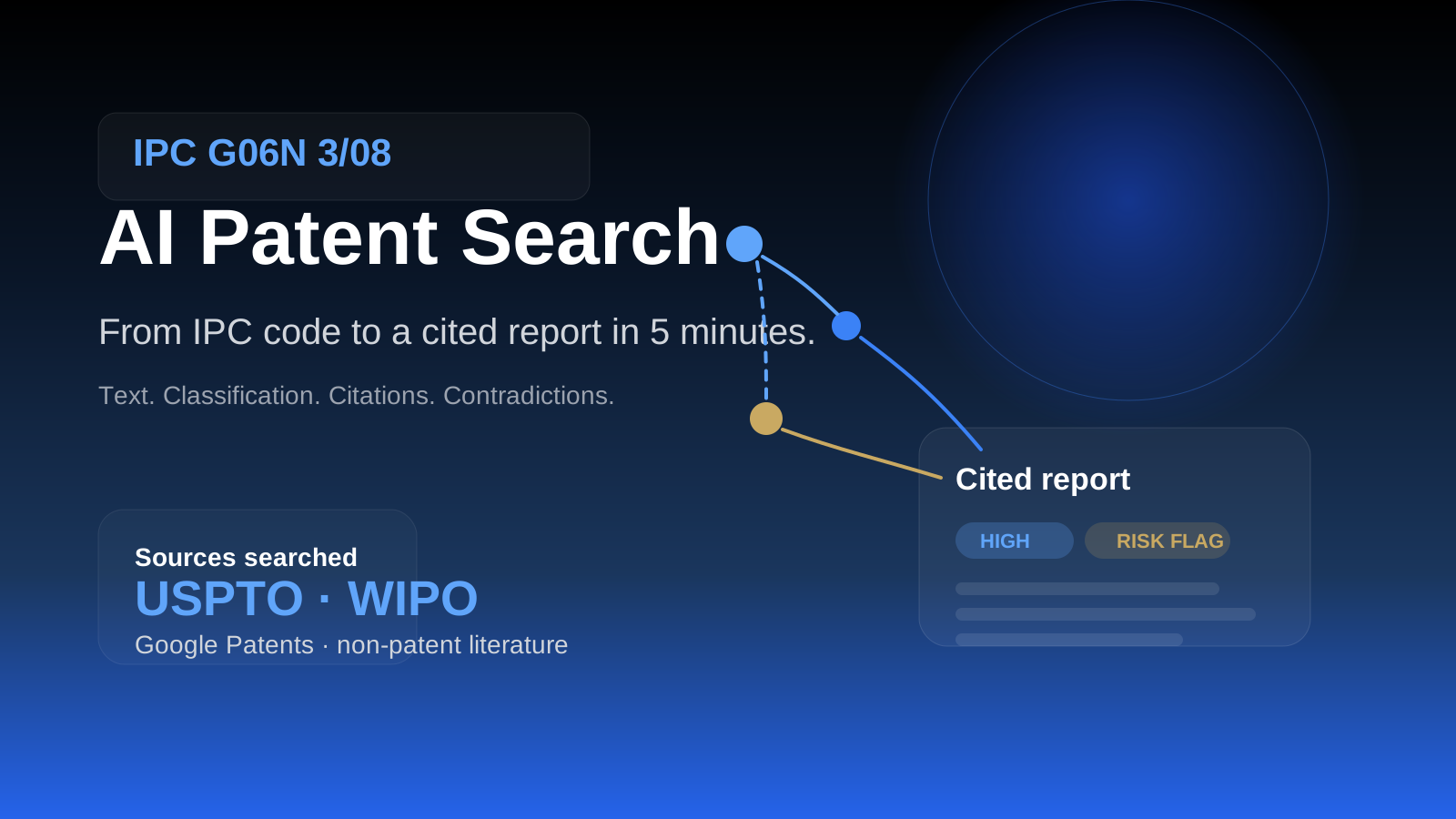
AI Patent Search: From IPC Code to Cited Report in 5 Minutes
Patent search is not one query. It is text, classification, citations, and non-patent literature across multiple databases. Here is the workflow that gets you from an IPC code to a cited report faster without pretending verification is optional.
Ready to try honest research?
Rabbit Hole shows you different perspectives, not false synthesis. See confidence ratings for every finding.
 Try free