

The Dirty Secret of AI Research: Why Speed Killed Accuracy
AI research tools hallucinate 20-40% of citations. Here's why the industry prioritized speed over accuracy and what it means for serious research.
You're a VC evaluating a biotech startup. You ask ChatGPT to dig up recent research on mRNA stability. It comes back with five citations, complete with DOIs and publication dates. You drop them into your due diligence memo. Three weeks later, a portfolio company engineer sends you a message: "Those citations don't actually exist. The DOIs are wrong. We can't build on assumptions that don't have sources."
This isn't hypothetical. This is happening in venture offices, consulting firms, and graduate labs every day.
The problem isn't new. AI models hallucinate. We know this. But what's surprising is how aggressively the AI research tool industry has optimized around this problem rather than solving it. The implicit bet: users will accept 30% false citations as long as we get them the answer in 10 seconds. Move fast, generate volume, let humans sort it out.
The financial and reputational cost of this tradeoff is enormous. But almost nobody talks about it.
The 20-40% Problem
Let me be specific about what we're talking about. Studies have shown that large language models hallucinate citations 20-40% of the time when asked to retrieve research. Sometimes the paper exists but the DOI is fabricated. Sometimes the title is real but the author is wrong. Sometimes the entire thing is invented—a phantom citation that sounds plausible but has never been published.
For a grad student, this means hours of manual verification. Click on the DOI, check PubMed or Google Scholar, realize the reference is bogus, start over. For a consultant writing a research note for clients, it means liability. If your cited research turns out to be fake, your credibility evaporates. For a VC, it means bad decisions. Investment theses built on nonexistent evidence.
The standard response from AI tool vendors? "Use it as a starting point. Always verify." In other words: we built the verification problem into the product. You get to own it.
This is like selling a GPS that works 70% of the time and telling drivers it's their responsibility to fact-check the directions.
Why Speed Won. (And Why It Shouldn't Have.)
To understand why we got here, you have to understand the optimization function of most AI research tools.
The metric that mattered was latency. How fast can we generate research? The faster we are, the more users we acquire. The more users, the better the defensibility. Speed became feature. Accuracy became edge case.
This made sense in 2023, when the whole category was new and users were experimenting. But we're in 2026. The users who stuck around are the ones with the highest cost of failure: finance analysts who stake millions on research conclusions, consultants who get paid for reliability, grad students whose publications depend on accurate citations.
For these users, accuracy isn't a nice-to-have. It's foundational.
The irony is that building for accuracy actually makes the tool more useful, not less. When a citation is verified across multiple sources and flagged with a confidence rating, you don't spend time second-guessing it. You use it. When a research finding has been cross-referenced and you can download the full paper directly, you move faster, not slower—because you're not drowning in manual verification work.
How Most Tools Handle This (Poorly)
There are basically three approaches vendors have taken:
1. The Disclaimer Approach: "Always verify everything. Here's a link to Google Scholar." This outsources the problem entirely. You're paying for research assistance but still doing 80% of the work yourself.
2. The Citation Button Approach: "Click here to verify this citation." Helpful in theory. In practice, many tools link to paywalled abstracts or outdated indexing services. You click. You hit a paywall. You're back to square one.
3. The Transparency Approach: "We show you our sources." But showing sources and verifying them are different things. Showing that a citation came from PubMed doesn't prove the data is correct. It just shows where we pulled it from.
All three approaches share a common assumption: the human should be the final arbiter of accuracy. Which is true in theory. But it's also true that humans aren't good at this task at scale. We're pattern-matching creatures. If a citation looks professional and specific, we assume it's real. We spot-check a few, see they're good, and lower our guard.
That's how bad citations slip into published research. That's how they make it into investment memos.
The Confidence Rating Model
Here's what actually works: reverse the optimization function.
Instead of optimizing for speed, optimize for confidence. Instead of prioritizing volume, prioritize reliability. Change the question from "How fast can we return research?" to "How confident can we be that this is true?"
This changes the architecture fundamentally.
A confidence-rated research finding isn't just a citation. It's a citation plus metadata: How many sources confirm this? Are they independent? Do they agree on the facts? Is there a dissenting view? How recent is the research? Has it been replicated?
When you implement this properly, something interesting happens. The research becomes faster to use, not slower, even though it took longer to produce. Because you're not second-guessing it. You're not spending cycles on verification. You can cite it directly.
Think about how you use cited research in a memo right now. You grab it, you put it in the draft, you spend 15 minutes wondering if you should verify it, you do a spot check, you move on. With confidence ratings, you know the check was already done. Multiple times. By different systems. You cite it and move on. The confidence rating is the proof.
Multi-Source Verification
Here's the second piece: verification isn't a single step, it's a process.
When you verify a citation, you're really asking multiple questions:
- Does this paper exist?
- Are the authors correct?
- Is the DOI/URL correct?
- What does the abstract actually say?
- Does it match the claim we're making?
- Has this been retracted or corrected?
- What did subsequent research find?
Most AI tools answer maybe one or two of these. Good tools answer all of them.
And you don't do it once. You do it across multiple sources. CrossRef for DOI verification. PubMed and Google Scholar for existence and authorship. ResearchGate for preprints. The Internet Archive for old papers that moved. Academic institution repositories. Publisher websites.
If a citation checks out across four independent sources, it's verified. If it only shows up in one, or if the sources contradict each other, you flag it. You mark the confidence level accordingly. "95% confident" vs. "45% confident" are very different statements.
The user now has a clear signal about what they can rely on.
The Downloadable Report Problem
There's one more layer here that almost nobody discusses: the audit trail.
A consultant sends a research-backed memo to a client. Six months later, the client's internal team digs into the citations and finds a problem. They ask: "Where did you get this?" The consultant doesn't have a clean answer. It came from an AI tool. The specific sources? They're buried somewhere in a chat history. The reasoning? Lost.
With Rabbit Hole, you get a downloadable report. This report includes:
- Every citation, verified and sourced
- The confidence rating for each finding
- The reasoning behind the confidence rating
- Links to the original source material
- Timestamps and version information
- The exact query used to generate the research
This is what "trustable AI research" actually means. Not just accurate research. Research you can defend. Research that comes with an audit trail.
This matters because it changes who can use the tool. Right now, if you work in finance or consulting or academia, you have to privately verify everything before using it in client work or published material. Which means the tool is really just a starting point. With verification built in and auditable, you can use it directly. You can cite it. You can stake credibility on it.
Why This Matters Now
The market is shifting. Clients are demanding certainty. Regulators are asking about AI in decision-making. Portfolio companies want to know their investment thesis is based on solid research, not hallucinated papers.
The vendors who figured out that accuracy and confidence are the real defensibility moat will be the ones who survive. Not the ones who can generate research fastest, but the ones who can generate research you can actually use.
Because speed without accuracy isn't a feature. It's a liability.
The dirty secret of AI research tools was that they prioritized speed over accuracy because it was easier to build and faster to gain users. The next generation flips this. It says: we'll take a little longer, but when we're done, you can cite it. You can trust it. You can build on it.
For grad students, consultants, finance analysts, and anyone else who gets paid for being right rather than fast, that's not a tradeoff. It's a feature you've been waiting for.
Ready to see confidence-rated research in action? Try Rabbit Hole and get downloadable reports with verified citations you can actually stake your reputation on.
Related Articles
The 2026 Buyer's Guide to AI-Powered Research Assistants
The best ai-powered research assistant in 2026 depends on whether you need a fast answer, a literature workflow, or a report you can actually defend after the meeting.

ChatGPT Deep Research vs Perplexity vs Rabbit Hole: Which One Cites Sources That Actually Exist?
If a deep research tool gives you a polished paragraph with one dead link or one unsupported claim, the report is already compromised. Here is the citation test that matters.
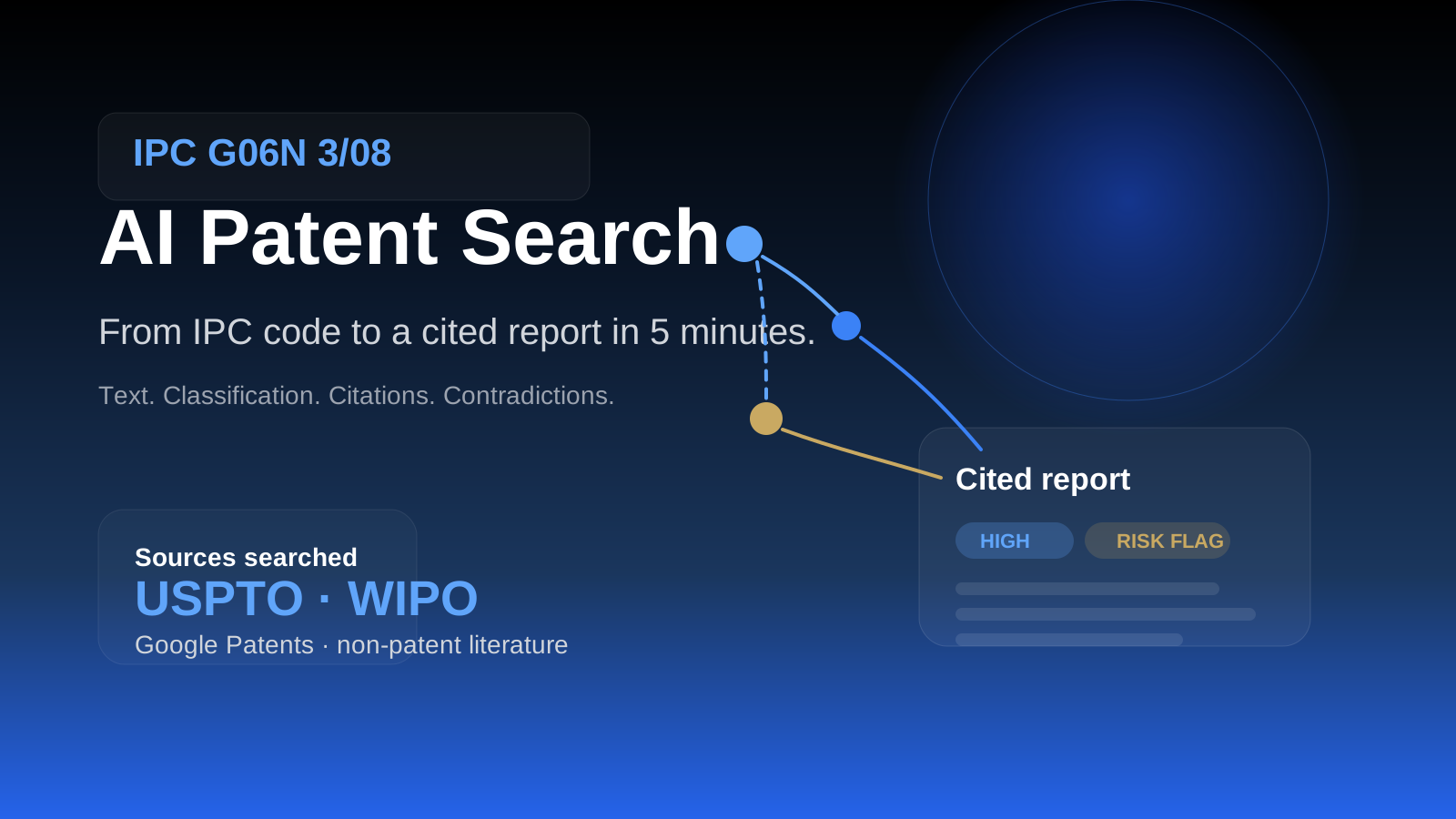
AI Patent Search: From IPC Code to Cited Report in 5 Minutes
Patent search is not one query. It is text, classification, citations, and non-patent literature across multiple databases. Here is the workflow that gets you from an IPC code to a cited report faster without pretending verification is optional.
Ready to try honest research?
Rabbit Hole shows you different perspectives, not false synthesis. See confidence ratings for every finding.
 Try free