

AI Competitor Analysis: How to Turn Public Signals Into a Real Strategic Read
AI competitor analysis is useful when it turns pricing, positioning, customer complaints, and market moves into a report you can challenge before acting.
AI competitor analysis matters because the real risk is not missing information. It is missing the pattern. Most teams can find the obvious things: competitor homepages, pricing pages, launch posts, and a few customer reviews. What they cannot do quickly is connect those fragments into a strategic read they would trust in a product review, a sales meeting, or a market-entry decision.
That tension is everywhere right now. Hacker News discussion today kept circling the same underlying problem from different directions: tooling trust, privacy fallout, and whether modern AI workflows are making people faster or just more certain. Competitor analysis breaks in the exact same way. A smooth summary is dangerous if it hides contradiction.
Quick verdict: The best AI competitor analysis workflow does not stop at a polished summary. It triangulates public reviews, pricing pages, launch signals, and buyer behavior, then keeps contradictions visible enough that a team can defend the strategic read.
Recent G2 and 6sense buyer research points to the same operational truth: competitor analysis has to compare independent evidence early, because buyers form preferences before most teams finish a spreadsheet.
Use this page fast: Need the workflow? Jump to How to run AI competitor analysis without wasting a day. Need the deliverable format? Skip to What a usable AI competitor analysis artifact looks like. Need the strategic use cases? Go to AI competitor analysis for positioning, sales, and market entry.
The workflow implication: an AI competitor analysis tool has to triangulate independent sources early, because buyers do not trust a polished homepage story on its own.
Those numbers come from recent G2 and 6sense buyer-behavior research summarized in Corporate Visions' 2026 buying-behavior analysis, and they reinforce the core requirement for AI competitor analysis: if the workflow cannot connect independent signals before your team makes a move, it is packaging confidence after the decision window has already passed. Corporate Visions 6sense Buyer Experience summary
AI competitor analysis tool: what to check in the first 2 minutes
| If the tool shows... | That usually means... | Decision value |
|---|---|---|
| Reviews, pricing pages, docs, and community threads in one report | It can triangulate beyond vendor-controlled narratives | Better for positioning and battlecard work |
| Confidence labels or source counts on claims | The output can be challenged instead of trusted blindly | Better for leadership-facing recommendations |
| Contradictions called out directly | The workflow is preserving mixed signals instead of smoothing them away | Better for high-stakes strategy bets |
| One clean narrative with no visible tension | You are getting synthesis theater, not real competitor analysis | Weak for decision support |
That 2-minute scan matters because teams rarely buy a competitor analysis tool just to save time. They buy it to avoid copying the wrong rival, chasing the wrong segment, or believing a polished story that falls apart under scrutiny.
What AI competitor analysis should actually answer
Good AI competitor analysis should help you answer four questions that change decisions:
- What is the competitor really optimizing for? Pricing, packaging, and proof reveal the buyer they actually want.
- What are customers praising and complaining about? Public reviews and community threads show where the product is strong, brittle, or oversold.
- What changed recently? New positioning, hiring patterns, feature launches, partnerships, and documentation edits often matter more than the static homepage.
- Where is the strategic opening? The point is not to admire their strategy. The point is to find the gap they are leaving behind.
Most teams stop at collection. They gather screenshots, dump notes into a doc, and call it competitor research. But competitive work only becomes useful when it forces a decision: attack here, avoid here, reposition here, or wait.
Why most AI competitor analysis outputs feel polished but thin
The failure mode is false neatness.
A single-model workflow often compresses the whole market into a tidy narrative: Competitor A is premium, Competitor B is affordable, Competitor C is innovative. That sounds coherent, but it is not analysis. Real competitor signals are usually mixed. A company can have premium pricing and weak customer love. It can be loud on social and invisible in procurement. It can launch features quickly while enterprise users complain the basics are unreliable.
If you are drowning in open tabs while trying to track these signals, the problem might be your workflow rather than your diligence. Read our guide to why tab hoarding is killing your productivity for a practical reset on research workflow hygiene.
If your AI competitor analysis output cannot preserve those contradictions, it pushes teams toward the wrong move: copying surface-level tactics instead of understanding the actual pressure points underneath them.
How to run AI competitor analysis without wasting a day
Start with a decision, not a generic research request.
Bad prompt: Analyze our competitors in AI note taking.
Better prompt: Compare the top AI note-taking products on pricing, positioning, customer complaints, feature emphasis, proof of value, and signs of enterprise readiness. Separate durable strengths from marketing language and flag where customer sentiment contradicts company claims.
That framing changes the output. It tells the system to hunt for disagreement, not just summary.
A practical workflow looks like this:
| Step | What to gather | Why it matters |
|---|---|---|
| Positioning | Homepage copy, category pages, launch posts, ad language | Reveals the buyer and outcome each competitor is trying to own |
| Packaging | Pricing tiers, feature bundles, usage limits, demo flows | Shows monetization logic and likely sales motion |
| Customer reality | G2, Reddit, support threads, app reviews, social discussion | Exposes what users repeat when the company is not in the room |
| Movement | Release notes, hiring, docs changes, partnerships, integrations | Indicates where the roadmap and go-to-market are heading |
If you are new to systematic research, our guide to how to research any topic covers the foundational skills for gathering multi-source evidence and building confidence in your findings.
That is what AI competitor analysis should automate: not just gathering source material, but structuring it into a report where claims are testable and strategic openings are obvious. If you need the category-level version of the same workflow, AI Market Research Tool shows how to turn review data, pricing pages, hiring signals, and public discussion into a decision-ready market view before you narrow in on named rivals.
The 10-minute competitor-read scorecard
| If the signal says... | Read it as... | What to do next |
|---|---|---|
| Reviews praise the outcome but complain about reliability | The wedge is real, but delivery is brittle | Test a "safer default" positioning and collect proof on consistency |
| Pricing is premium but implementation support looks thin | They are monetizing urgency faster than customer success can absorb it | Push a lower-friction pilot or onboarding angle |
| The homepage promises AI magic but docs stay narrow and tactical | Marketing moved before product depth did | Compare launch language against real workflows before copying the narrative |
| Hiring ramps in one function while public messaging stays flat | Strategy is shifting before the brand catches up | Watch that function for the next 30-60 days and prepare a response early |
| Social buzz is loud but review volume stays shallow | Awareness is outrunning buyer conviction | Treat it as a distribution event, not proof of product strength |
The fastest way to make AI competitor analysis useful is to turn raw signals into a scorecard like this before writing the big summary. It forces the team to translate evidence into a move, not just admire the pattern.
What a usable AI competitor analysis artifact looks like
If the deliverable is just five paragraphs of prose, you still have a note-taking problem.
A useful competitor-analysis report should include:
- Executive read: who is strong where, who is weak where, and what remains uncertain
- Competitor grid: positioning, price, proof, channel, and obvious tradeoffs
- Customer signal section: repeated praise, repeated pain, and unusual outliers
- Confidence labels: what is strongly supported versus what is directional
- Recommended action: the most credible angle to test next
Rabbit Hole is built for that kind of output. This is the kind of artifact you can actually bring into a strategy conversation:
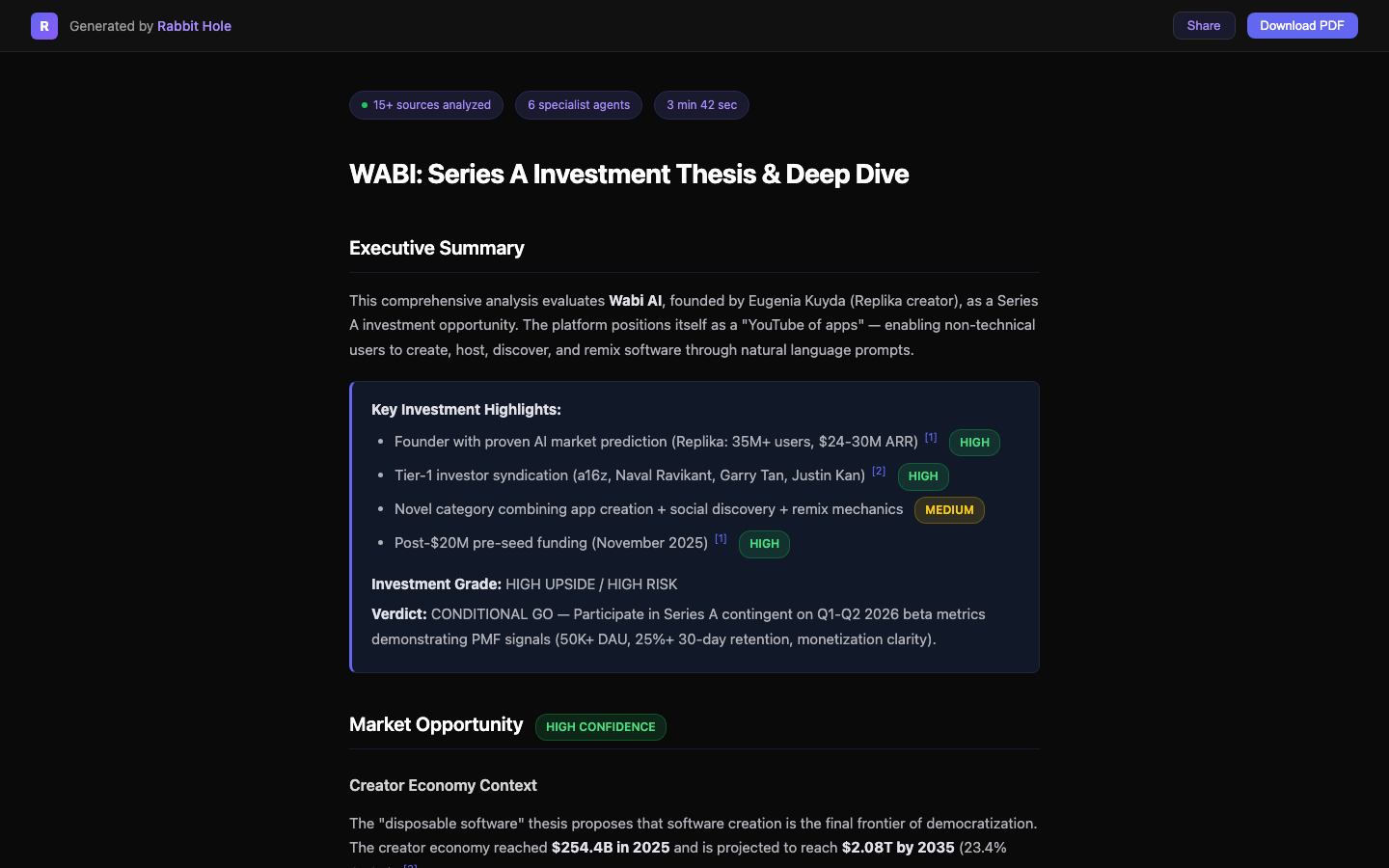
The key detail is the confidence layer. In competitor work, every sentence should not look equally true. Pricing scraped from a live page is one kind of evidence. A Reddit thread with ten comments is another. A rumor repeated on X is another. Strategic judgment improves when the report keeps those evidence levels visible.
AI competitor analysis for positioning, sales, and market entry
The biggest advantage of AI competitor analysis is not speed by itself. It is speed with structure.
AI competitor analysis for product positioning
When a team says, "we need better positioning," what they usually need is a sharper map of what competitors keep promising versus what buyers still find missing. That gap is where differentiated language comes from. If you want the manual version of that process, read Competitive Intelligence Without the Spyware Budget.
AI competitor analysis for market-entry decisions
When you are considering a new category, competitor analysis should tell you whether the market is crowded everywhere or just crowded in one layer. Sometimes every company sounds similar at the headline level but leaves the same buyer pain unsolved underneath. That is why AI Market Research Tool is the adjacent workflow: category truth and competitor truth need to be read together.
AI competitor analysis for high-stakes diligence
The closer the work gets to budget, hiring, board review, or investment, the less tolerance you have for vibes. You need claims you can check and red flags you can defend. If the decision is about one company rather than the category, AI Due Diligence is the stricter version of the same discipline.
FAQ: AI competitor analysis
What is AI competitor analysis?
AI competitor analysis is the use of AI to collect, compare, and synthesize public competitor signals such as pricing, positioning, reviews, launch activity, documentation changes, and customer complaints. The useful version is not just faster research. It is research packaged so the team can challenge the conclusion before acting on it.
What should an AI competitor analysis report include?
A decision-ready report should include competitor positioning, pricing, repeated customer complaints, recent strategic moves, confidence labels on claims, and a recommended action. If the report hides disagreement between sources, it is still a summary, not analysis.
What is the difference between AI competitor analysis and market research?
AI competitor analysis focuses on named rivals and the strategic openings between them. Market research asks whether the category itself is attractive, growing, or saturated. If you need the category-level view first, start with AI Market Research Tool, then use competitor analysis to decide where to attack.
Why Rabbit Hole works as an AI competitor analysis tool
Rabbit Hole fits AI competitor analysis because it treats the job as a multi-source evidence problem. It can search pricing pages, review sites, public discussions, documentation, and other public artifacts in parallel, then return a structured report instead of a conversational blob.
That matters when the question is not "what do competitors say?" but "what should we do because of what competitors say, charge, ship, and fail to deliver?"
If that is the bar, try Rabbit Hole. It is built for teams that need competitor analysis they can challenge, share, and act on.
Related Articles

The 2026 Buyer's Guide to AI-Powered Research Assistants
The best ai-powered research assistant in 2026 depends on whether you need a fast answer, a literature workflow, or a report you can actually defend after the meeting.

ChatGPT Deep Research vs Perplexity vs Rabbit Hole: Which One Cites Sources That Actually Exist?
If a deep research tool gives you a polished paragraph with one dead link or one unsupported claim, the report is already compromised. Here is the citation test that matters.
AI Patent Search: From IPC Code to Cited Report in 5 Minutes
Patent search is not one query. It is text, classification, citations, and non-patent literature across multiple databases. Here is the workflow that gets you from an IPC code to a cited report faster without pretending verification is optional.
Ready to try honest research?
Rabbit Hole shows you different perspectives, not false synthesis. See confidence ratings for every finding.
 Try free